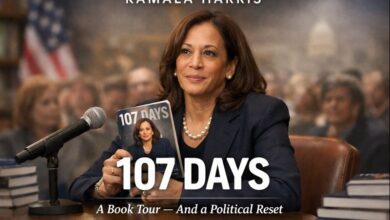
Democrats’ 2028 Nomination Race Begins Early: Harris, Newsom and a Crowded, Unsettled Field

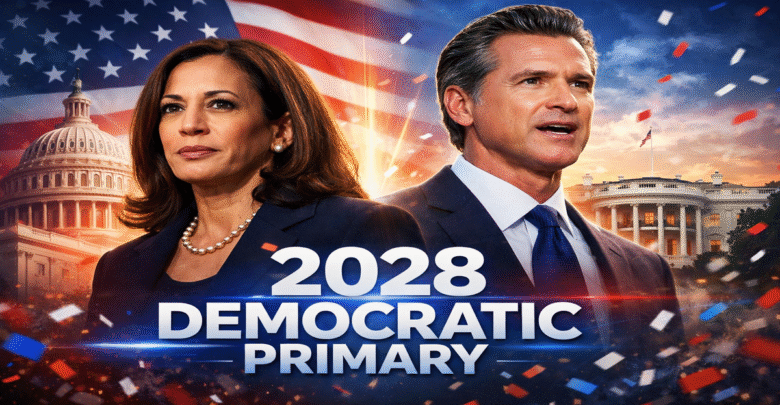
With the 2028 U.S. presidential election still years away, the Democratic Party’s next nomination fight is already taking shape—not through formal announcements, but through donor travel, early-state visits, headline-grabbing speeches, and the soft-launch choreography that has become standard in modern American politics. The early contours point to a familiar dynamic: a party searching for a unifying national message after a bruising cycle, while ambitious figures position themselves as the next standard-bearer.
Two names dominate most early conversations: Kamala Harris and Gavin Newsom—both Californians with national profiles, both skilled communicators, and both facing questions about electability, ideology, and coalition-building in a party that spans progressives, moderates, labor, and increasingly influential younger voters. Early polling aggregates and media reporting also suggest a second tier of contenders—governors and senators—who could surge if the front-runners stumble or if Democratic voters decide they want a generational or stylistic reset. Wikipedia+2AP News+2
Why the 2028 Democratic primary is starting “now”
In the U.S., presidential races begin long before candidates formally declare. Prospective contenders often:
- campaign for other Democrats in Iowa/New Hampshire/South Carolina/Nevada-style early testing grounds,
- build national fundraising lists and small-dollar networks,
- sharpen their message against the sitting administration and the opposing party, and
- cultivate party activists and institutional support.
The Associated Press has documented how prominent Democrats have been appearing in early battlegrounds and early-primary states well ahead of voting, even while insisting their trips are about supporting local candidates. AP News+1
Kamala Harris: strengths, vulnerabilities, and a plausible comeback lane
Harris enters any 2028 conversation with structural advantages: near-universal name recognition among Democrats, deep national donor relationships, and strong ties to core Democratic constituencies—particularly Black voters and many suburban professional voters. Early polling summaries show Harris as either leading or narrowly competing at the top of the Democratic field in various averages. Wikipedia+1
Her strengths
- Coalition memory: Democratic primary voters tend to reward familiarity—especially candidates who have already built relationships across state parties and activist networks.
- Fundraising infrastructure: Harris can reactivate national fundraising quickly, including small-dollar and high-dollar channels.
- Issue credibility with key blocs: On abortion rights, voting rights, and judicial appointments, she fits comfortably within the Democratic mainstream.
Her vulnerabilities
- “Been there” fatigue: If party voters want a fresh face after a turbulent decade, a return to a prominent national figure can be framed as backward-looking.
- California branding problem: Even many Democrats acknowledge a risk that “California” becomes a shorthand attack line in swing states (crime, housing costs, homelessness), regardless of nuance.
- Message clarity: Harris’s 2028 path is strongest if she presents a crisp narrative: what she learned, what she’d do differently, and why she is uniquely positioned to beat the Republican nominee.
Still, recent reporting indicates Harris has continued to draw speculation about 2028 and remains a central figure in party discussions. Desert Sun+1
Gavin Newsom: the loudest anti-Trump messenger—and an activist favorite
Newsom has spent years building national visibility, often positioning himself as one of the party’s most aggressive communicators against Republican governance. Politico reported that Newsom drew notable attention at a Democratic National Committee gathering, energizing activists and fueling 2028 buzz. Politico
His strengths
- Combativeness in a polarized era: Many Democratic activists believe the party needs a sharper-edged messenger against MAGA politics. Newsom’s confrontational style plays well in that lane. Politico
- Executive experience: As California governor, he can credibly claim experience managing a huge economy and bureaucracy—useful in a general election argument about competence.
- Media fluency: He is comfortable in rapid-response politics and digital messaging, which increasingly shapes primary momentum.
His vulnerabilities
- Electability skepticism outside blue states: Newsom must convince primary voters he can win the “middle” of the Electoral College map, not just the coasts.
- California’s policy baggage: Opponents will spotlight homelessness, affordability, and business climate debates—fairly or not—as a national warning label.
- Primary coalition math: Newsom’s path requires strong performance with Black voters and union-heavy Midwestern blocs—groups where Harris (and some governors) may have an advantage.
Harris vs. Newsom: the key contrasts that may define the race
If the contest narrows to Harris vs Newsom, expect four big dividing lines:
- Coalition vs. persuasion
Harris’s best argument is coalition continuity—keeping the Democratic base together and preventing defections. Newsom’s best argument is persuasion—winning back swing voters through sharper contrast politics and a “fighter” persona. - Identity and generational messaging
Democrats will debate whether the nominee should embody continuity with recent national leadership or signal a generational shift. Both are of the same political era, but their brands differ: Harris as an established national figure; Newsom as a governor pushing into national space. - Governing record scrutiny
In a long primary, the governing record becomes an ad. Each will be asked to defend California outcomes and explain how lessons translate nationally. - Style: prosecutor vs. pugilist
Harris often leans into disciplined, institutional messaging. Newsom leans into confrontation and rapid counterpunch politics. Democratic voters will decide which is more effective in 2028’s media environment.
The “second tier” that could become first tier
Behind Harris and Newsom, several Democrats routinely appear in early polling or media shortlists, including:
- Pete Buttigieg (national profile; strong communicator; appeals to some moderates and younger voters) Wikipedia+1
- Josh Shapiro (governor-style pragmatism; often cited as a potential national leader) Wikipedia+1
- JB Pritzker (wealthy governor with national ambitions speculation) AP News+1
- Andy Beshear (red-state Democrat brand; has publicly suggested he’d consider a run, according to compiled reporting) Wikipedia+1
- Alexandria Ocasio-Cortez (progressive star; polling occasionally shows her competitive in hypotheticals, even as her own next move remains uncertain) The Daily Beast+1
This group matters because Democratic primaries often reward momentum and contrast. If Harris and Newsom split establishment donors and institutional endorsements, a “third option” could rise—especially a governor with a strong economic story or a candidate who captures younger voters and online energy.
Issues likely to dominate Democratic primary debates
Even without knowing the exact 2028 Republican nominee, Democratic primary fights tend to revolve around (1) what the party stands for and (2) what it must do to win.
Expect these policy and narrative arenas to loom large:
- Cost of living and housing: Democrats face pressure to show they can reduce rent, health costs, and everyday inflation anxieties without sounding technocratic.
- Democracy and rule of law: Still a mobilizing theme for many Democrats; candidates will argue over how to protect institutions while also reforming them.
- Immigration and border governance: A persistent vulnerability in general elections; Democrats will debate enforcement vs. humanitarian framing.
- Climate and industrial policy: Balancing climate goals with jobs, energy reliability, and competition with China.
- Technology, AI, and labor: Regulation, job displacement, and national competitiveness—issues rising in salience across advanced economies.
Can Democrats avoid a civil war between factions?
A key strategic question is whether the party can keep its ideological wings aligned. Progressives want bolder moves on healthcare, climate, Gaza/foreign policy ethics debates, and corporate power. Moderates want a nominee who can win Pennsylvania, Michigan, Wisconsin, Arizona, Georgia, and Nevada.
The most successful 2028 Democrat will likely be the one who:
- signals empathy and urgency to the base,
- speaks plainly to persuadable voters, and
- projects competence on governance.
That is why Harris vs Newsom is so compelling: it’s partly a debate about what kind of fight Democrats think they are in—a base-mobilization battle, a persuasion battle, or both.
What to watch next
Over the next 6–12 months, watch for:
- early-state travel (especially South Carolina and New Hampshire-style proving grounds), AP News+1
- major endorsements by prominent governors, labor unions, and key members of Congress,
- small-dollar fundraising signals (email list growth; viral moments),
- policy “signature” releases that look like national platforms, and
- polling movement in early averages tracking Harris/Newsom and the second tier. Wikipedia+1