

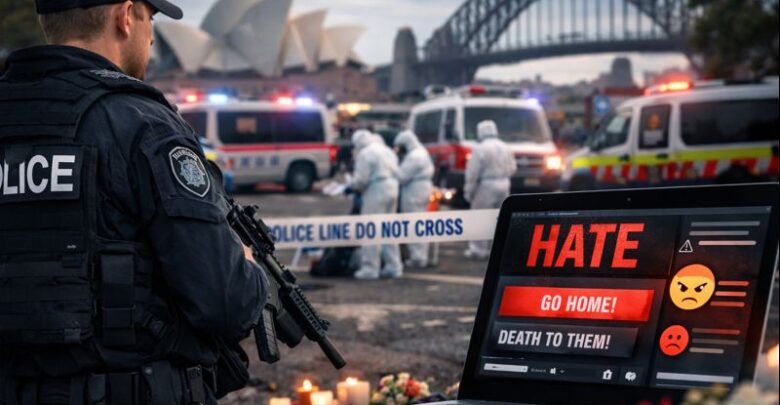
Australia has intensified its crackdown on hate speech and extremist rhetoric following a violent firing incident in Sydney, reigniting a nationwide debate over public safety, freedom of expression, and the role of law enforcement in countering ideologically motivated violence. The incident has prompted federal and state authorities to reassess existing hate speech laws, online regulation frameworks, and counter-extremism strategies amid growing concerns over radicalisation and community cohesion.
The Sydney shooting, though still under investigation, has become a flashpoint in Australia’s broader struggle to address hate-fuelled violence without undermining democratic freedoms. As political leaders, security agencies, and civil society groups weigh in, the episode marks a significant moment in Australia’s evolving approach to extremism and social harmony.
The Sydney Firing Incident: What We Know So Far
The firing incident occurred in Sydney, Australia’s largest city and a global multicultural hub. While authorities have been cautious in releasing full details due to the ongoing investigation, early assessments suggest the incident may have been influenced by ideological or hate-based motivations, triggering immediate concern at the highest levels of government.
Law enforcement agencies moved swiftly to secure the area, reassure the public, and prevent escalation. No broad conclusions have yet been officially confirmed, but the event has highlighted the persistent risks posed by lone-actor violence, online radicalisation, and inflammatory rhetoric—particularly in densely populated urban centres.
The incident follows a pattern seen in several Western democracies, where isolated acts of violence increasingly intersect with extremist narratives circulated both online and offline.
Government Response: Zero Tolerance for Hate-Driven Violence
In the aftermath of the Sydney firing, Australian leaders have reiterated a zero-tolerance policy toward hate speech and incitement to violence. Senior officials stressed that while Australia remains committed to free expression, there is a clear legal and moral boundary when speech fuels hatred, discrimination, or violence against individuals or communities.
Federal authorities have signalled stronger enforcement of existing legislation, alongside potential amendments to close perceived loopholes—particularly in the digital space. State governments, including New South Wales, have also announced closer coordination with federal agencies to monitor extremist activity and respond more rapidly to emerging threats.
Existing Hate Speech Laws in Australia
Australia’s hate speech framework is spread across federal, state, and territory laws, making enforcement complex but comprehensive.
Key elements include:
- Racial Discrimination Act 1975, which prohibits offensive behaviour based on race, colour, or national or ethnic origin
- Criminal Code provisions addressing terrorism-related advocacy and incitement
- State-level laws criminalising threats, harassment, and vilification
- Online Safety regulations, overseen by the eSafety Commissioner
While these laws have been in place for years, critics argue that enforcement has struggled to keep pace with the speed and reach of digital platforms, encrypted messaging services, and transnational extremist networks.
The Online Dimension: Social Media and Radicalisation
A major focus of the renewed crackdown is the role of online platforms in amplifying hate speech and extremist content. Investigators increasingly point to social media algorithms, anonymous forums, and messaging apps as accelerators of radicalisation.
Following the Sydney incident, Australian authorities have renewed calls for:
- Faster removal of extremist and hate-based content
- Stronger cooperation from technology companies
- Improved transparency in content moderation policies
- Greater accountability for platforms hosting harmful material
Australia was among the first countries to introduce penalties for social media companies that fail to remove violent extremist content promptly, and officials now suggest that these powers may be expanded or more aggressively enforced.
Balancing Free Speech and Public Safety
The crackdown has revived a long-standing debate: where does free speech end and dangerous speech begin?
Civil liberties advocates caution against overly broad definitions of hate speech that could suppress legitimate political dissent or critical debate. They argue that laws must be applied carefully, transparently, and proportionately to avoid chilling effects on democratic discourse.
On the other hand, community leaders—particularly from minority groups—stress that unchecked hate speech creates an environment in which violence becomes more likely. They contend that freedom of expression does not include the right to dehumanise, threaten, or incite harm against others.
Australian courts have traditionally sought to strike a balance, but the Sydney firing incident has sharpened public demand for decisive action.
Impact on Multiculturalism and Social Cohesion
Australia prides itself on being one of the world’s most successful multicultural societies, with Sydney often cited as a model of diversity. However, incidents linked to hate or extremist ideologies pose a direct challenge to that identity.
Community organisations have warned that repeated exposure to hateful rhetoric—whether online or in public spaces—erodes trust between groups and increases social fragmentation. In response to the latest incident, several interfaith and civic groups have called for:
- Expanded community-based prevention programs
- Dialogue initiatives to counter polarisation
- Education campaigns addressing misinformation and prejudice
The government has acknowledged that law enforcement alone cannot solve the problem and that long-term resilience depends on social inclusion and community engagement.
Counter-Extremism Strategy: Beyond Policing
Australia’s counter-extremism framework increasingly emphasises early intervention rather than solely punitive measures. Programs aimed at identifying at-risk individuals, supporting disengagement from extremist ideologies, and strengthening mental health services are gaining renewed attention.
Security experts note that many recent violent incidents in Western countries involve individuals who were known to authorities but fell through institutional gaps. The Sydney firing has intensified calls for better information-sharing between agencies and improved resourcing for prevention initiatives.
Political Consensus and Points of Disagreement
Despite sharp political divides on many issues, there is broad bipartisan agreement in Australia that hate-fuelled violence represents a serious national security and social threat. Major parties have largely supported tougher enforcement measures, though differences remain over scope, oversight, and safeguards for civil liberties.
Some lawmakers advocate new legislation explicitly criminalising certain forms of ideological incitement, while others prefer strengthening enforcement of existing laws rather than introducing new statutes.
Australia in a Global Context
Australia’s renewed focus on hate speech mirrors trends in other democracies grappling with similar challenges. Governments in Europe and North America are also revisiting legal frameworks to counter extremist rhetoric, particularly in the wake of violent incidents linked to ideological radicalisation.
Analysts note that Australia’s approach—combining legal action, platform regulation, and community engagement—places it among the more proactive countries in this domain. However, they caution that effectiveness will depend on consistent implementation and public trust.
What Comes Next?
As investigations into the Sydney firing continue, further policy announcements are expected in the coming weeks. Possible developments include:
- Enhanced powers for regulators overseeing digital platforms
- Increased funding for counter-extremism and community programs
- Clearer legal definitions around incitement and vilification
- Expanded public reporting on hate-related incidents
The government has emphasised that measures will be guided by evidence and consultation, aiming to strengthen public safety without compromising democratic values.
Conclusion: A Defining Test for Australian Democracy
The Sydney firing incident has become more than an isolated act of violence—it is a defining test of Australia’s ability to confront hate and extremism while preserving freedom, diversity, and the rule of law.
As Australia tightens its crackdown on hate speech, the challenge will be ensuring that enforcement is firm but fair, targeted but not overreaching. The outcome of this moment will shape not only security policy but also the broader social contract in an increasingly complex and polarised world.
