
Trump vs Rubio: Conflicting Narratives Expose Deep Fault Lines in U.S. Iran War Strategy

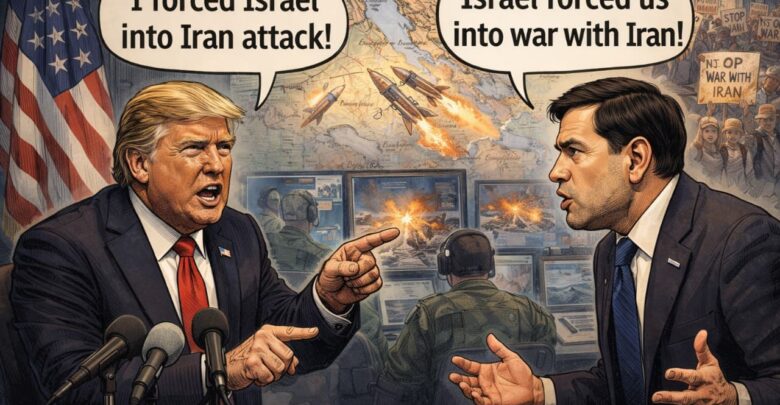
In an extraordinary public clash inside the U.S. war room narrative, President Donald Trump has directly contradicted the account offered by his own Secretary of State, Marco Rubio, about why the United States launched military strikes against Iran. The conflicting explanations have sent shockwaves through Congress, ignited fierce political debate across American society, and intensified concerns over the legality and strategic clarity of the only major Middle East conflict the U.S. has been involved in for decades.
Two Competing Stories from the White House
On Monday, Rubio suggested that the timing of U.S. strikes against Iran was heavily influenced by Israeli intentions, implying Washington acted in part to pre-empt retaliation after Israeli plans became clear — a statement that fed into widespread perceptions that U.S. foreign policy had become closely aligned with Israeli strategic interests.
But in a stunning rebuttal just 24 hours later, Trump — speaking from the Oval Office with reporters present — rejected that framing. He insisted that Israel did not force the United States into war and instead claimed that if anyone’s hand was moved, it was his forcing Israel’s hand, arguing he believed Iran was on the verge of launching attacks first. “If anything, I might have forced Israel’s hand,” Trump said, emphasizing that the U.S. acted on its own judgment of an imminent threat.
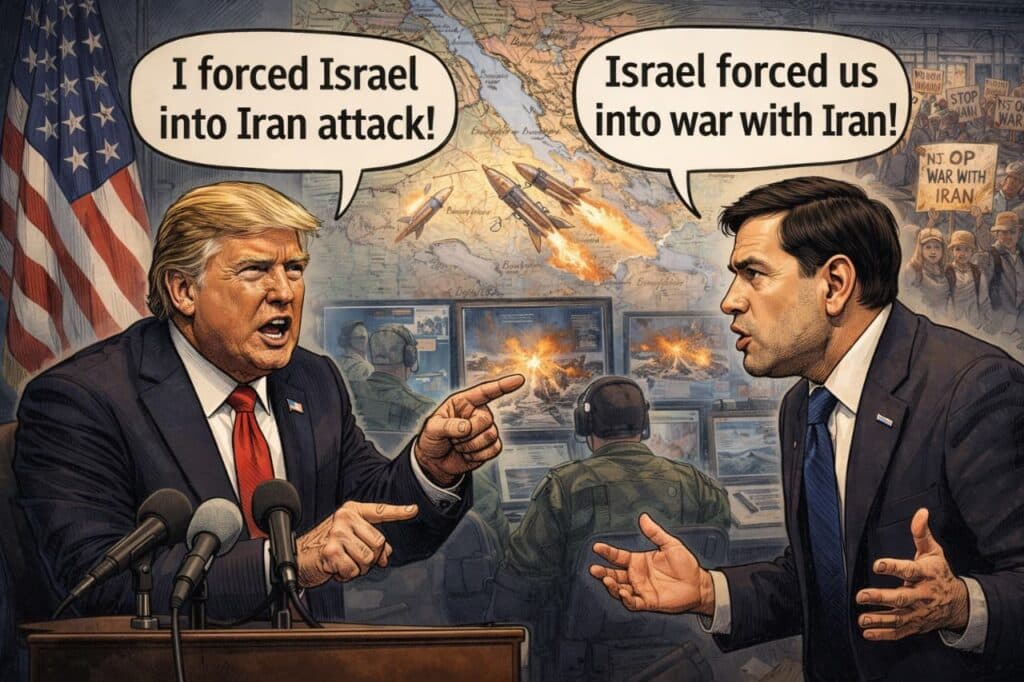
The contradiction exposed a deeper problem for the administration: no unified public rationale for why America committed to a major military conflict, leaving lawmakers and the public deeply skeptical and uneasy.
Why the Mixed Messaging Matters
The conflicting accounts are more than just political squabbles; they strike at the heart of American foreign policy credibility. If the public narrative shifts daily — from pre-emption to alliance-driven action to independent defense — it fuels perceptions that the U.S. entered this war with confused motives rather than clear national interests.
This internal incoherence has fed a growing narrative on Capitol Hill, among media commentators, and among the American electorate: that the administration lacks a coherent strategy and is failing to justify the immense cost of war — both in American lives and global stability.
The War Rages On, Justifications Shift
The debate over why the war began matters deeply because the conflict itself continues to escalate:
Trump has claimed U.S.-led strikes have “knocked out” much of Iran’s military infrastructure across air, naval, and defense systems — without offering a clear endgame.
Six U.S. service members are confirmed killed in the conflict, and Iran’s retaliatory strikes continue to challenge U.S. bases in the Gulf.
Global markets and diplomatic relations are under strain as the war’s long-term repercussions become clearer.
These developments underscore the human and economic cost of a conflict whose public rationale remains deeply contested. Citizens from both major U.S. political parties are asking hard questions about why American service members are involved in a foreign conflict with murky strategic benefits and shifting explanations.
Domestic Political Backlash Intensifies
Across the United States, lawmakers from both Democratic and Republican camps are responding with alarm:
Democrats have pushed for robust Congressional oversight, with many insisting the administration violated constitutional norms by launching strikes without a formal authorization vote and without a consistent public rationale.
Republicans loyal to Trump are defending the president’s decisions, though even within GOP ranks critical voices argue that contradictory messaging undermines America’s strategic posture.
A growing faction of lawmakers, especially those focused on constitutional war powers and budget oversight, are openly debating whether Congress should take back authority from the executive branch and potentially limit ongoing operations.
Public Sentiment: Confusion Fuels Outrage
The American public has reacted with bewilderment and anger to the administration’s shifting narratives:
Polling data shows broad skepticism, with many Americans expressing discomfort about engaging in major combat without clear, consistent justification from national leadership. Public opinion is influenced not only by Trump and Rubio’s contradictory statements but also by broader concern about U.S. involvement in another prolonged Middle East war.
Protests have erupted in multiple major cities, with demonstrators condemning what they see as an unnecessary conflict that endangers both American soldiers and foreign civilian populations — particularly after reports of significant civilian casualties and infrastructure destruction inside Iran.
Critics argue that the war reflects competing political narratives rather than a unified presidential doctrine — deepening public mistrust in leadership at a time when national unity is sorely needed.
International Reactions Amplify U.S. Policy Confusion
External voices have also weighed in on the confusion:
Iranian officials and international observers have seized upon the inconsistency in U.S. explanations to argue that the conflict has less to do with American security and more to do with alliance politics, diplomatic pressure, and geopolitical rivalries.
Global allies and adversaries alike are watching Washington’s messaging with concern, as credibility and diplomatic pressure can be severely weakened when top officials publicly offer contradictory rationales for war.
This international scrutiny intensifies pressure on the U.S. administration to provide a more unified, evidence-based justification for its continued military engagement.
The Bigger Picture: America First or Warfare First?
As Trump and Rubio trade conflicting accounts, the broader debate has crystallized into a battle over the soul of U.S. foreign policy. For many critics, the war illustrates a pivot away from “America First” isolationism toward a more interventionist posture — one that Trump’s base initially resisted.
This contradiction — between campaign rhetoric favoring restraint and a wartime reality rooted in shifting alliances and strategic ambiguity — fuels broader public and political dissatisfaction with the administration’s handling of the conflict.
The question now reverberating throughout Washington, state capitals, and dinner tables across the nation is simple but profound:
Is the United States acting in clear national interest, or is its foreign policy being shaped by reactive alliances and internal confusion?
Conclusion: A War Defined by Confusion
The public contradiction between President Trump and Secretary of State Rubio — whether Israel influenced the initial strike, or whether Trump forced Israel’s hand, or whether the U.S. acted independently — has become emblematic of a larger crisis of messaging and mission in the ongoing war with Iran.
With American lives at stake, civilian casualties mounting abroad, and political dissent growing at home, the demand for clarity, transparency, and accountable leadership has never been louder.
For now, the U.S. war room is not only managing a battlefield far from its shores — it is also scrambling to manage a narrative that is unraveling in real time.


