
California Governor Newsom Calls U.S.–Israeli War on Iran Illegal, Warns of Risks to American & Iranian Lives

California Governor Newsom Declares U.S.–Israeli War on Iran “Illegal”, Warns of Risks to American Lives and Iranian Children
The decision by President Donald Trump to launch major military strikes against Iran has inflamed political tensions across the United States. On the ground in California and in national capitals, leaders, lawmakers, and ordinary citizens are questioning the legality and justification of a war that critics say risks American lives, destabilizes the region, and has already resulted in the deaths of Iranian civilians — including children.
At the forefront of the domestic backlash is Gavin Newsom, governor of the nation’s most populous state. In a forceful rebuke, Newsom labeled the administration’s military action “illegal” and “dangerous”, warning that it endangers U.S. service members and fails to justify the human cost — especially the loss of innocent life abroad.
Newsom’s Sharp Criticism of the War
In statements shared widely on social media and in press briefings, Newsom criticized the Trump administration for acting without clear congressional authorization and without convincing evidence of an imminent Iranian threat. Although acknowledging the brutality of Iran’s regime, the governor stressed that military strikes that kill civilians — including reports of schoolchildren killed in Iranian cities — cannot be justified as lawful or in America’s strategic interest.
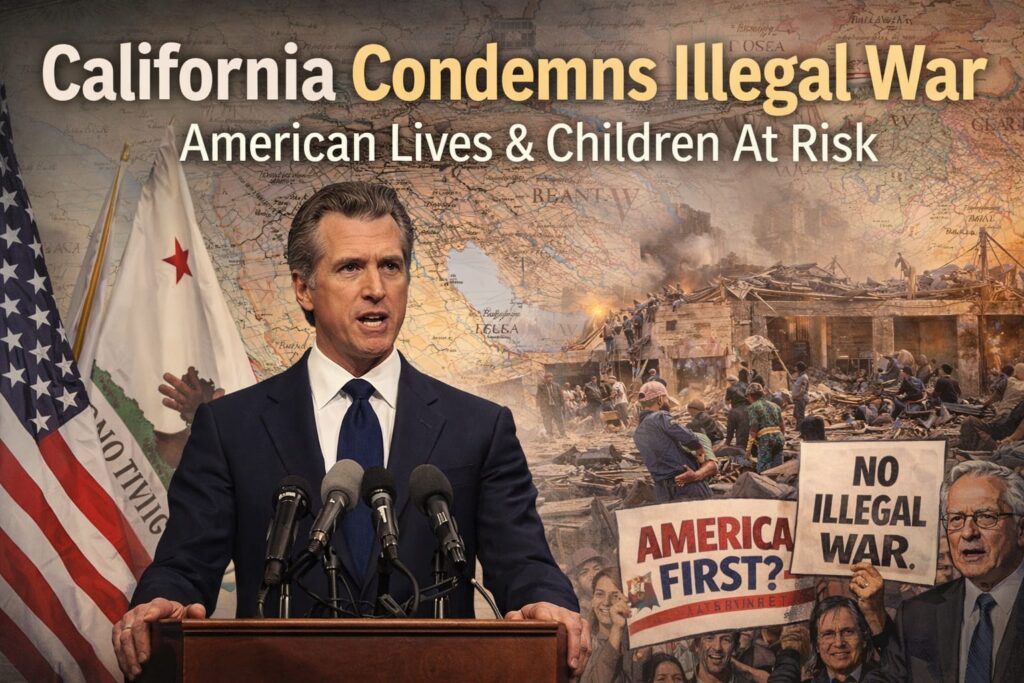
“The leadership of Iran must go. But that does not justify the President of the United States engaging in an illegal, dangerous war that will risk the lives of our American service members and our friends without justification to the American people.” — Governor Gavin Newsom on X.
Newsom’s emphasis is not only on legal grounds but also on moral responsibility. He has repeatedly stated that sending U.S. troops into harm’s way — and conducting strikes that have reportedly hit civilian infrastructure and schools — undermines the very principles the United States claims to protect.
Legal, Constitutional, and Ethical Objections
A key pillar of Newsom’s critique is constitutional: only Congress has the authority to declare war. Critics across California and beyond argue that the absence of a formal congressional vote makes this military action an unconstitutional extension of executive power.
Several lawmakers from California echoed this stance, including Rep. Doris Matsui, who called the strikes “an illegal and irrational attack” that risks American lives without a clear strategy or public mandate.
This constitutional concern is echoed nationally. Prominent senators, including members of the Democratic Party and even some Republicans, have argued that Trump bypassed the War Powers Resolution and the Constitution by initiating hostilities without congressional approval.
🇺🇸 “America First” vs. Escalation Abroad
At the heart of the domestic debate is a broader question: Does waging an unauthorized war abroad align with an “America First” policy? For many Californians — and a growing segment of Americans — the answer is a resounding no.
Newsom and other critics argue that the conflict has shifted U.S. foreign policy from prioritizing American interests to becoming entangled in a wider regional conflict aligned with Israeli strategic priorities — a point that many anti-war protests across the country are now highlighting.
This sentiment has fueled protests in major U.S. cities, including large demonstrations in California, where activists hold signs condemning the war as a “War of Choice” and demanding that Congress exercise its constitutional authority to limit further engagement.
Public Response: Protests and Polarization
Across the United States, protests have erupted in opposition to both the war and the administration’s rationale for it. Grassroots groups, student organizations, veterans’ associations, and peace activists have organized rallies in cities from San Francisco to New York.
Many of these demonstrations focus on:
The civilian cost of war, especially reports of children killed in airstrikes;
The lack of a clear legal mandate from Congress;
The absence of transparent evidence of an imminent Iranian threat;
Concerns that the war will embroil America in another long, costly conflict.
The protests have at times drawn tens of thousands of participants, while smaller counter-demonstrations support the administration’s stance. Regardless of numbers, the intensity of the protests underscores deep divisions within the U.S. public.
Civilian Casualties — Especially Children — Stoke Outrage
International and Iranian sources report significant civilian casualties — including children — from the joint U.S.–Israeli airstrikes. Iranian state media has claimed that a strike hit a girls’ school, killing numerous children and staff, though independent verification is limited.
These reports have become central to the moral and political uproar. Newsom and others have seized on the images and accounts of innocent victims to argue that the U.S. role in the conflict is not merely misguided, but morally indefensible without clear evidence of imminent danger.
Human rights advocates and global critics have amplified this narrative in international forums, decrying the use of force without exhausting diplomatic options.
National Political Reactions and Partisan Divide
While Newsom represents a strong Democratic critique of the conflict, reactions among U.S. political leaders vary.
Several Democratic leaders have called for congressional votes to constrain further military action, insisting the U.S. shouldn’t be pulled deeper without legislative oversight.
Some Republican lawmakers, in contrast, have framed the strikes as necessary to deter Iranian escalation and defend allies.
This partisan split is intensifying debates within Congress and the electorate about U.S. foreign policy priorities.
A Turning Point in U.S. Foreign Policy?
Newsom’s statements — and the broader backlash — may signal a turning point in how Americans perceive their country’s role in the world. The debate juxtaposes:
A traditional interventionist stance tied to alliance commitments;
A growing isolationist or restraint-focused sentiment centered on legal oversight, moral accountability, and prioritizing domestic concerns.
Critics argue that another costly foreign war diverts attention and resources from pressing domestic challenges, including economic inequality, healthcare, and infrastructure. Newsom has linked his opposition to the war with broader concerns about government accountability and national priorities.
Conclusion: California’s Governor as a Voice of Dissent
Governor Gavin Newsom’s condemnation of the U.S.–Israeli military campaign against Iran resonates far beyond California’s borders. His statements — framed around constitutional process, human costs, and moral responsibility — have crystallized a larger debate about American values, priorities, and the limits of executive power in foreign policy.
For many Americans, the Iran conflict is no longer just about Middle East geopolitics — it’s about whether U.S. leadership should be anchored in accountability and national interest or driven by external pressures and strategic alliances.
As the war continues and protests march on, this debate will likely shape political discourse through the 2026 midterms and beyond.


