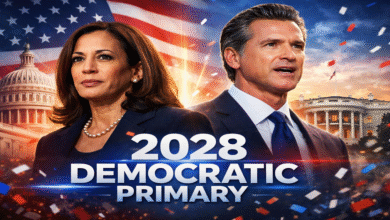
Kamala Harris Steps Back Into the National Spotlight: Media Blitz, 107 Days BooK Tour, and Quiet Signals Toward 2028

Washington | Analysis
Former U.S. Vice President Kamala Harris has re-emerged with renewed intensity on the national stage, sparking widespread speculation about her political future. Through a carefully calibrated mix of television appearances, high-profile media interviews, a nationwide book tour for 107 Days, and selective public remarks, Harris appears to be repositioning herself—deliberately and methodically—for what many Democratic strategists believe could be a serious bid for the 2028 U.S. presidential race.
While Harris has stopped short of making any formal announcement, the pattern of her recent engagements—rather than any single statement—suggests a politician preparing the ground well ahead of the next electoral cycle.
A Strategic Media Re-Entry, Not a Casual Comeback
Harris’s recent television appearances have been neither random nor reactive. Instead, they reflect careful message discipline, a hallmark of early-stage presidential positioning.
In multiple prime-time interviews, Harris has focused on:
- The future of American democracy
- The state of civil liberties
- The role of executive leadership in moments of crisis
- Lessons learned during her tenure as vice president
Notably absent is any overt criticism of Democratic rivals or party factions. Instead, Harris has emphasized continuity, experience, and readiness—a framing that subtly reinforces her credentials as someone already tested at the highest level of government.
Political communication experts note that such appearances serve dual purposes: reintroducing a familiar figure to voters while recalibrating public perception. For Harris, whose vice-presidential tenure was often overshadowed by broader administration dynamics, the current media strategy allows her to speak in her own voice.
107 Days: A Memoir With a Political Subtext
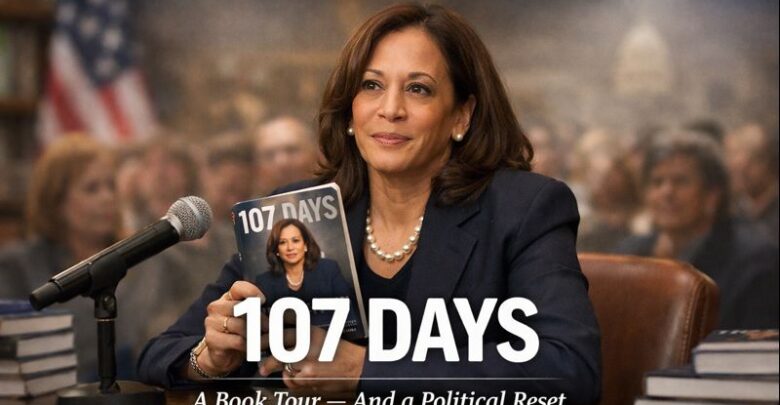
At the center of Harris’s renewed visibility is her book, 107 Days, which chronicles the condensed and turbulent presidential campaign she mounted in 2020 before joining the Biden ticket.
On the surface, the book reads as a reflective political memoir. Yet beneath its narrative structure lies a more strategic function.
Why 107 Days Matters Politically
The book:
- Revisits Harris’s executive decision-making under pressure
- Reframes earlier campaign missteps as learning experiences
- Positions her as a leader shaped by adversity rather than defeated by it
- Humanizes her political journey without diminishing ambition
Importantly, Harris does not treat her 2020 run as a failed experiment but as unfinished political business. In several passages and interviews promoting the book, she speaks about timing, political maturity, and institutional readiness—language often used by politicians preparing for a second, more calculated run.
The Book Tour as a De Facto Listening Campaign
Harris’s 107 Days tour spans multiple states, including key Democratic strongholds and emerging battleground regions. While officially framed as a literary and civic engagement exercise, the tour resembles what political insiders recognize as an early “listening campaign.”
At town halls, university events, and moderated discussions, Harris:
- Engages directly with voters on economic anxiety and governance
- Listens to grassroots concerns without committing to policy platforms
- Tests messaging around leadership, justice, and democratic resilience
- Rebuilds connections with Democratic activists and donors
Such tours historically serve as soft launches—allowing potential candidates to gauge public reception without triggering the scrutiny of a declared race.
Media Interactions Reflect a Shift in Tone
Another notable feature of Harris’s recent appearances is a discernible tonal shift. Compared to earlier years, she appears more relaxed, more conversational, and less constrained by institutional messaging.
Her interviews emphasize:
- Personal accountability
- Political realism
- A willingness to discuss governance challenges openly
- The importance of coalition-building within a polarized electorate
This recalibration addresses long-standing critiques of Harris as overly scripted, while presenting her as a leader comfortable with complexity—an attribute crucial for a presidential contender.
Revisiting Her Past Statements: Signals Hidden in Plain Sight
Although Harris has not publicly declared an intention to run in 2028, her past statements provide important context.
She has consistently said that:
- “Public service is not about ambition—it’s about responsibility.”
- “Leadership means being ready when the moment demands it.”
- “Democracy requires constant defense, not occasional participation.”
In recent interviews, she has subtly updated this language, speaking about future challenges, long-term leadership, and the next generation of governance. Observers note that such phrasing keeps political options open while aligning with presidential-level discourse.
Notably, Harris has not ruled out a future run when asked directly—choosing instead to emphasize ongoing civic engagement. Historically, this ambiguity is a classic signal of political preparation rather than withdrawal.
Positioning Within the Democratic Party Landscape
The Democratic field for 2028 remains fluid. Governors, senators, and emerging national figures are expected to compete for influence in the coming years.
Harris’s advantage lies in:
- National name recognition
- Executive-level experience
- Established donor networks
- Deep ties to Democratic institutions
Her current strategy avoids early factional battles, instead positioning her as a unifying figure with proven resilience. By focusing on governance rather than ideology, Harris appeals to both the Democratic base and centrist voters—an essential coalition for a general election.
Why Timing Matters
Harris’s re-emergence comes at a moment when:
- Voters show fatigue with perpetual political conflict
- Leadership experience is increasingly valued
- Democratic voters are reassessing generational transition within the party
By acting early—but not prematurely—Harris gains time to reshape her narrative, address vulnerabilities, and demonstrate political growth without the pressure of immediate electoral deadlines.
A Campaign Without a Declaration
Taken individually, Harris’s recent activities could be dismissed as routine post-office engagement. Viewed collectively, however, they form a coherent political strategy.
The media appearances, the book tour, the messaging discipline, and the careful ambiguity all point in one direction: Kamala Harris is preparing—methodically and deliberately—for a potential 2028 presidential run.
Whether she ultimately enters the race will depend on political conditions, party dynamics, and public reception. What is clear, however, is that Harris is no longer on the sidelines of American politics. She is back in the national conversation—by design, not by accident.