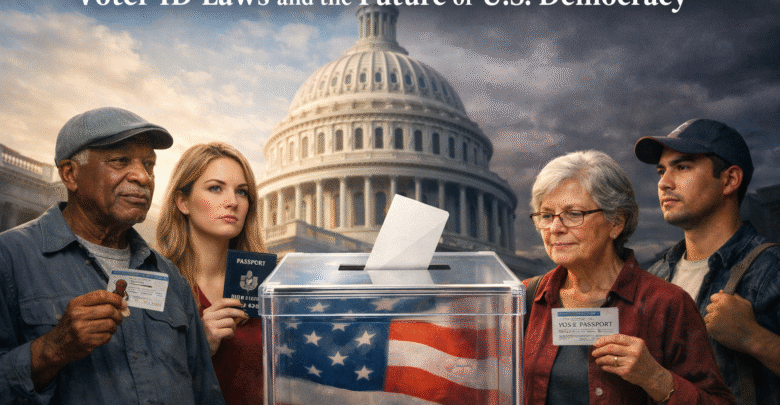
The most notable federal effort to change voter identity law is the Safeguard American Voter Eligibility Act (SAVE Act), now often referenced in its revived form as the SAVE America Act.
What the Bill Proposes
Originally introduced by Republican lawmakers in 2025 and passed by the House of Representatives, the SAVE Act would require “documentary proof of United States citizenship” to register to vote in federal elections. Under the bill’s language, acceptable proof could include a passport or certified birth certificate — far stricter than current federal law which relies on self-attestation and indirect verification through databases.
A new 2026 version of the bill adjusts some provisions but still imposes nationwide rules that would be unprecedented in modern U.S. elections. Among the key measures:
- Mandatory Photo ID at the Polls: Voters would have to present a government-issued photo ID to cast a ballot.
- Proof of Citizenship Documentation: Potential voters might be required to provide a passport or birth certificate when they register — documents not held by millions of U.S. citizens.
- Stricter Roll Maintenance: States could be required to regularly affirm that their voter rolls contain only citizens, potentially triggering aggressive “clean-ups.”
Republicans argue the bill is a common-sense measure to ensure only eligible citizens vote, framing it as a necessary step to safeguard elections from fraud. However, critics — including Democrats, voting rights advocates, and civil liberties organizations — argue the legislation amounts to a nationalized voter suppression scheme, one that disproportionately impacts low-income voters, the elderly, students, and others less likely to hold the specified documentation.
Criticism and Legal Concerns
Opposition to the SAVE Act has been fierce. Democratic leaders in the Senate have denounced it as a form of voter suppression, with Senate Minority Leader Chuck Schumer calling it “Jim Crow 2.0.”
Legal experts point out that requiring extra documentary proof beyond what is currently used — such as a driver’s license or state ID — could disenfranchise millions. An analysis by the Brennan Center for Justice estimated that tens of millions of citizens do not possess a readily available passport or certified birth certificate, particularly affecting women who have changed their names through marriage, people with limited mobility, and economically disadvantaged groups.
There are also constitutional questions about federal vs. state power. Under the U.S. Constitution, states traditionally control most aspects of how elections — especially voter registration and polling procedures — are conducted. Some legal analyses argue that a president cannot unilaterally impose voter ID or citizenship verification requirements without new congressional statutes, and even then the federal reach into state-run elections could face Supreme Court challenges.
State-Level Voter ID Measures: Ballot Initiatives and Laws
While federal legislation dominates national headlines, a parallel wave of state-level voter identity reforms is unfolding across America. Several states have either approved constitutional amendments or are considering ballot measures that would require photo ID or tighter citizenship requirements:
- Nevada’s Question 7: Already overwhelmingly approved by voters once in 2024, this constitutional amendment requiring voter ID will appear again on the 2026 ballot for final ratification.
- North Carolina’s Voter ID Amendment: A proposed state constitutional amendment would mandate photo identification for all ballots — including mail and in-person voting — on the 2026 ballot.
These state reforms reflect a broader trend of conservative state governments pushing for stricter identification laws, often framing them as necessary for election security. But opponents argue these changes risk marginalizing rural, minority, and student voters who may not easily access the required documentation.
Democratic Responses and Alternative Legislation
Democrats and civil rights groups are not sitting idle. On the federal level, proposals like the John Lewis Voting Rights Advancement Act aim to reinforce rather than restrict access to the ballot box — by restoring elements of the landmark 1965 Voting Rights Act and requiring federal oversight of changes to voting laws in areas with histories of discrimination.
Some Democratic-led state legislatures are even considering compromises on voter ID in exchange for broader expansion of voting access measures — such as more early voting, mail-in ballot accommodations, and stronger protections for ballot drop boxes.
The clash between restrictive identity laws and access-focused reforms represents a deeper philosophical divide in U.S. politics: Is the priority securing the integrity of elections through stricter rules, or expanding participation by lowering barriers?
Voter Identity and the Midterm Stakes
The voter identity debate isn’t just about administrative details — it has real political consequences. Elections are decided by turnout, and changes that make voting harder for certain groups could shift the electorate in ways that influence which party controls Congress after the 2026 midterms.
Republicans see tighter rules as a way to respond to complaints about election legitimacy from 2020 and 2024. Democrats, meanwhile, warn that tightening access could disproportionately harm their voter base — including young people, people of color, and low-income citizens. Research suggests that groups historically underrepresented at the polls are also more likely to lack the specific documentation required under stricter ID laws.
As the midterms approach, voter identity legislation — whether at the federal or state level — will continue to dominate news cycles, court battles, and grassroots organizing.
Conclusion: A Defining Battle Over Democracy
The controversy over voter identity laws is far more than a technical policy debate. It touches the core of American democracy: Who gets to participate in choosing the government? The outcome of this legislative struggle will have lasting implications for the rights of citizens and the shape of political power in the United States for years to come.
For now, the SAVE Act’s future in the Senate remains uncertain, and state ballot measures like Nevada’s Question 7 and North Carolina’s amendment are on track to become major 2026 focal points. Meanwhile, voting rights advocates are pushing competing frameworks aimed at protecting and expanding access to ballots.
Whatever happens, voter identity policies will be central to the story of the 2026 U.S. midterm elections — a story of legitimacy, access, and the very meaning of democratic participation.