Gulf Allies Reconsider U.S. Security Umbrella as Iran War Reshapes Regional Alliances

Dateline: Middle East | March 11, 2026 (PST)
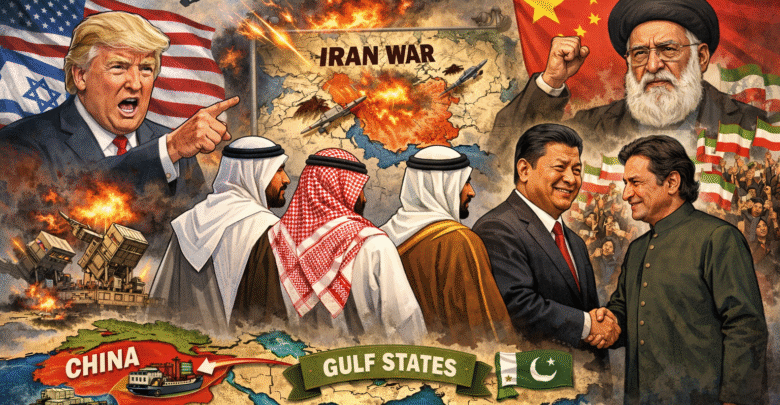
The escalating confrontation between the United States–Israel alliance and Iran is triggering a major geopolitical recalibration across the Gulf, as several long-standing American partners quietly distance themselves from Washington’s strategy.
For decades, Gulf monarchies relied heavily on U.S. military protection and defense systems. But the current crisis has exposed growing doubts in regional capitals about whether Washington’s priorities still align with their economic and security interests.
Gulf Reluctance to Join the War
Despite strong pressure from Washington, key Gulf states have declined to directly support military operations against Iran. Countries such as Saudi Arabia, the United Arab Emirates, Qatar, and Oman have largely maintained a cautious stance, prioritizing regional stability over participation in a widening war.
Saudi Arabia’s refusal to back the campaign militarily has been particularly striking. Riyadh has instead emphasized diplomacy and de-escalation, reflecting fears that a prolonged regional war could devastate Gulf economies, energy infrastructure, and global oil markets.
Behind the scenes, Gulf officials are increasingly concerned that the current U.S. policy appears heavily focused on defending Israel while offering little reassurance regarding the security of Arab partners.
Perception of a Weakening Security Shield
Another factor influencing Gulf calculations is the performance of advanced defense systems. The recent wave of Iranian missile and drone attacks has tested the credibility of Western-supplied air defense networks across the region.
Although many threats have been intercepted, the scale and persistence of Iranian strikes have exposed vulnerabilities that Gulf policymakers cannot ignore. Some analysts argue that this has shaken confidence in the long-standing assumption that American military technology guarantees absolute protection.
Israel itself has faced sustained missile barrages, further fueling debate in regional security circles about whether purely military solutions can deter Iran.
Assassination Backfires Politically
The assassination of Iran’s Supreme Leader—widely attributed to covert action linked to the broader conflict—appears to have produced unintended consequences.
Instead of destabilizing Tehran, the event has rallied large segments of Iranian society around the government. Nationalist sentiment surged, strengthening domestic cohesion at a moment when external pressure was expected to fracture the system.
Many observers now warn that the strategy may have hardened Iran’s resolve while making diplomatic off-ramps more difficult.
China and Regional Powers Move In
As uncertainty grows around the reliability of American leadership, other powers are positioning themselves to expand influence in the Gulf.
China has already deepened economic partnerships with major regional players through energy agreements, infrastructure projects, and security dialogue. Beijing’s approach—focused on trade, investment, and political neutrality—has gained traction among governments eager to avoid choosing sides in great-power rivalries.
At the same time, regional diplomacy has also intensified. Pakistan’s recent quiet mediation efforts between Saudi Arabia and Iran have reportedly helped prevent renewed tensions between the two rivals at a critical moment.
Such initiatives reflect a broader shift toward regional conflict management rather than reliance solely on external powers.
A Region Entering Strategic Transition
The Middle East now appears to be entering a transitional phase. Gulf states are not abandoning their relationships with Washington, but they are increasingly pursuing multi-vector foreign policies—balancing ties with the United States while expanding engagement with China and regional partners.
If the current conflict continues to escalate, the long-standing U.S. security architecture in the Gulf may face its most serious test in decades.
For Washington, the challenge will be convincing its traditional allies that their strategic and economic interests remain central to American policy in the region.
For Gulf leaders, the lesson of the crisis may be clear: the future of regional security could depend less on a single protector and more on a carefully balanced network of partnerships.