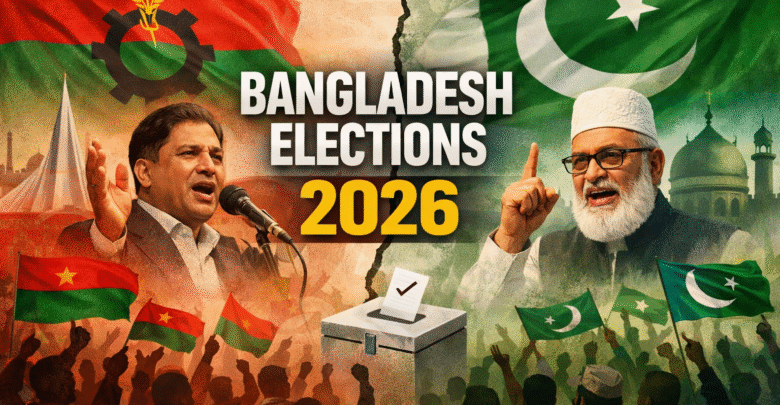
Bangladesh Elections 2026: BNP and Jamaat Neck-and-Neck as Nation Faces Most Unpredictable Vote in Decades

Introduction
Bangladesh stands on the brink of one of the most closely contested elections in its modern political history. With millions of voters heading to the polls, the political environment is defined by uncertainty, shifting alliances, and unusually tight projections. Analysts widely agree that the race between the Bangladesh Nationalist Party (BNP) and Jamaat-e-Islami (JI) is too close to call, with both parties positioned on almost equal footing nationally.
Unlike previous elections dominated by a single political force, the current contest reflects a competitive and fragmented landscape where minor swings in turnout, regional performance, or undecided voters could determine which party forms government and which moves into opposition.
A Historic Election in a Transitional Era
This election is taking place after a period of political transition that reshaped Bangladesh’s power structure. The country is voting in a post-realignment atmosphere where older political certainties have weakened and newer alignments have emerged.
The transitional phase has not produced a clear front-runner. Instead, it has opened political space for multiple parties, particularly strengthening competition between BNP and Jamaat, both of which now command significant organizational capacity and nationwide support networks.
Political observers say the election is less about ideology alone and more about which party can mobilize voters more effectively on polling day.
The Two Leading Forces
Bangladesh Nationalist Party (BNP)
The BNP enters the election as a traditional heavyweight with decades of political experience, a broad grassroots base, and established regional leadership structures. It draws support from rural constituencies, middle-income households, and voters seeking administrative continuity and economic stability.
Its campaign messaging focuses on governance reforms, institutional strengthening, and economic management. Supporters argue that BNP’s long political history gives it the experience needed to run government effectively during a sensitive transitional period.
Jamaat-e-Islami (JI)
Jamaat, meanwhile, has undergone a political resurgence. Once viewed primarily as a secondary or coalition-dependent force, it has expanded its influence across urban centers, youth demographics, and parts of the professional class.
Its campaign strategy emphasizes organizational discipline, social welfare messaging, and appeals to younger voters seeking alternatives to traditional political elites. Observers note that Jamaat’s ability to mobilize motivated grassroots supporters could offset BNP’s broader but sometimes less concentrated voter base.
For the first time in decades, analysts say Jamaat is not merely competing — it is a realistic contender to lead or co-lead the next government.
Polling Data: Statistical Dead Heat
Surveys conducted in recent months consistently show extremely narrow margins between the two parties. While different polls produce slightly different numbers, the overarching trend is clear: neither side holds a decisive advantage.
Across major polling aggregates:
- Some projections show BNP ahead by only about one percentage point.
- Others place Jamaat within the margin of error of BNP.
- Several polls indicate a statistical tie, where differences are too small to be considered predictive.
A significant portion of voters — in some surveys approaching one-fifth of respondents — remain undecided. In an election this tight, undecided voters alone could determine the outcome.
Why the Race Is So Close
Analysts point to structural political factors that have produced this rare equilibrium.
1. Fragmentation of Traditional Voting Blocs
Political loyalties that once favored dominant parties have splintered, redistributing support across multiple groups.
2. Demographic Divide
Younger voters show different preferences than older voters, preventing either party from building a dominant cross-generational coalition.
3. Regional Variations
Certain provinces favor BNP while others lean toward Jamaat, producing a geographically balanced contest.
4. Competitive Campaigning
Both parties have run highly active campaigns with strong ground mobilization and digital outreach, minimizing gaps in visibility.
5. Transitional Political Climate
Because the country is emerging from a major political shift, voters are more open to change, experimentation, or strategic voting.
Turnout: The Ultimate Deciding Factor
Perhaps the single most decisive variable is voter turnout. Analysts suggest turnout levels could tilt the result in either direction.
- Higher turnout tends to benefit parties with broader national networks.
- Lower turnout can favor parties with highly motivated core supporters.
Current turnout projections fall within a range where either outcome is plausible. That uncertainty reinforces the consensus view that the election is genuinely unpredictable.
Key Issues Driving Voters
Despite ideological differences between the parties, surveys show voters are primarily concerned about everyday governance issues rather than partisan narratives.
The most frequently cited voter priorities include:
- Maintaining law and order
- Managing inflation and prices
- Combating corruption
- Strengthening institutions
These concerns cut across party lines, meaning both BNP and Jamaat are competing on similar policy terrain rather than sharply divergent agendas.
The Youth Vote: A Potential Game-Changer
Bangladesh’s electorate includes a large proportion of young voters, many casting ballots for the first time. Political scientists emphasize that younger voters are less tied to traditional party loyalties and more responsive to campaign messaging, social media outreach, and grassroots mobilization.
If youth turnout is high, it could significantly influence results. Because younger voters are spread across party preferences rather than concentrated in one camp, their participation may reinforce the close nature of the race rather than produce a landslide.
Minority and Stability Concerns
Human-rights observers and civil-society groups stress that peaceful conduct of the election will be critical for national stability. Minority communities and independent observers are closely monitoring the process, emphasizing the importance of transparency, security, and institutional credibility.
Regardless of which party wins, analysts agree that maintaining post-election stability will be as important as the election itself.
Possible Post-Election Scenarios
Given current projections, several realistic outcomes exist:
Scenario 1 — Narrow BNP Victory
BNP could win slightly more seats and form a government, but likely with a slim majority or coalition partners.
Scenario 2 — Narrow Jamaat Victory
Jamaat could edge ahead if turnout patterns favor its core supporters or if undecided voters break in its favor late.
Scenario 3 — Hung Parliament
One of the most plausible scenarios is a legislature where neither party holds a majority, requiring coalition negotiations or power-sharing arrangements.
Scenario 4 — Coalition or Unity Government
If results are extremely close or contested, parties could consider a coalition or temporary unity government to ensure political stability.
Regional Significance
The election is being closely watched across South Asia and internationally. Bangladesh occupies a strategic geographic and economic position, and its political direction affects regional trade, maritime security, and diplomatic alignments.
Foreign policy analysts emphasize that regardless of which party wins, continuity in international relations is likely, though policy emphasis could shift slightly depending on leadership priorities.
Expert Consensus: Too Close to Predict
Most political analysts, polling agencies, and regional observers agree on one central conclusion: the election cannot currently be predicted with confidence.
Key reasons include:
- Polling margins within statistical error
- High number of undecided voters
- Turnout uncertainty
- Regional voting variations
In modern electoral politics, races this tight typically remain uncertain until final vote counts are completed.
Conclusion
Bangladesh’s 2026 election represents a pivotal democratic moment defined not by dominance but by competition. The contest between the BNP and Jamaat-e-Islami has evolved into one of the closest political races in the country’s history, with both parties standing on nearly equal ground.
Rather than a clear favorite, voters face a genuine choice between two viable contenders. The final result will likely depend on turnout, late-deciding voters, and local constituency dynamics.
Whichever party ultimately forms the government — and whichever moves into opposition — the next leadership will inherit a politically energized electorate and a nation expecting stability, reform, and effective governance.
In that sense, the defining feature of this election is not which party leads today, but how evenly matched they remain until the very end.