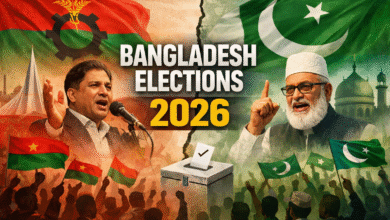
Bangladesh Elections 2026: Coalition Politics, Democratic Moderation, and the Logic of the Citizen Party–Jamaat-e-Islami Alliance


By Israr Ullah Khan
As Bangladesh approaches its next general elections, one of the most consequential political developments has been the emerging alliance between the Citizen Party and Jamaat-e-Islami (JI). Much of the commentary surrounding this partnership—particularly from rigid secular quarters—has framed it as an ideological anomaly or a destabilising gamble. Such interpretations, however, overlook the country’s recent political trajectory, voter behaviour, and the internal evolution of Jamaat-e-Islami as a constitutional political actor.
Viewed through a historical, electoral, and institutional lens, the alliance appears neither unnatural nor extreme. Rather, it reflects political convergence born of shared resistance, electoral pragmatism, and a gradual shift toward moderation through coalition politics.
Shared Resistance and Political Convergence
Both the Citizen Party and Jamaat-e-Islami emerged as prominent actors in opposition to the Sheikh Hasina–led political order. While their social bases and ideological languages differ, their experience of authoritarian governance converged.
Jamaat-e-Islami paid a particularly heavy price over the past decade, including:
- the execution of senior leaders,
- prolonged incarceration of its top cadre,
- deregistration and exclusion from electoral politics,
- sustained administrative and legal pressure.
Despite this, Jamaat did not resort to armed struggle, underground militancy, or unconstitutional routes to power. Instead, it persisted—often under severe constraints—within the framework of constitutional politics, legal contestation, and alliance-building.
The Citizen Party, emerging from student-led protest movements, confronted the same political environment. The alliance between the two is therefore best understood not as transactional, but as a convergence shaped by common political adversity.
Voter Behaviour and Electoral Transferability
A common assumption among critics is that ideological dissonance within the Citizen Party will significantly undermine the alliance at the ballot box. This assumption overestimates elite ideological rigidity and underestimates voter pragmatism.
Bangladesh’s electoral history suggests that:
- voters tend to follow party and alliance cues in high-stakes elections,
- organisational discipline and credibility matter more than ideological purity,
- internal dissent among elites rarely translates into mass voter defection.
Against this backdrop, it is reasonable to expect that a substantial majority—likely 70 to 80 percent—of voters aligned with both parties will support joint alliance candidates. Limited resistance from hardline secularists within the Citizen Party, while visible in media discourse, represents a narrow ideological segment rather than the electoral mainstream.
The median Bangladeshi voter remains moderate, seeking stability, representation, and accountability rather than ideological absolutism.
Coalition Politics as a Moderating Mechanism
Coalition-building in democratic systems often functions as a moderating force, compelling parties to adjust rigid positions and articulate policies in inclusive, pragmatic terms. The Citizen Party–Jamaat alliance is no exception.
- The Citizen Party is pushed to translate protest-era legitimacy into governance-oriented programs.
- Jamaat-e-Islami, operating within a broader coalition, is incentivised to frame its political vision in civic and constitutional language, rather than ideological abstraction.
This dynamic reduces the space for extremism on both ends of the spectrum. Bangladesh’s experience suggests that political polarisation has historically been driven less by coalition politics than by ideological absolutism, whether secular or religious.
Jamaat-e-Islami: Reformist Roots and Democratic Pathways
Concerns surrounding Jamaat-e-Islami often stem from misreadings of its intellectual foundations.
The party’s founding thinker, Syed Abul Ala Maududi, is frequently portrayed as a revolutionary ideologue. In fact, his political thought emphasised:
- rejection of violent revolution,
- opposition to coups and clandestine seizures of power,
- commitment to gradual reform through democratic participation,
- reliance on societal consensus rather than coercive state action.
Maududi’s insistence on constitutional and democratic pathways was so pronounced that several members departed Jamaat in the early 1950s, dissatisfied with its refusal to adopt revolutionary methods. This episode underscores Jamaat’s non-revolutionary orientation, often overlooked in contemporary critiques.
Constitutional Commitments and Minority Protections
A review of Jamaat-e-Islami’s constitutional documents and core literature reveals positions that contrast sharply with popular caricatures.
Key elements include:
- explicit commitment to achieving political objectives through peaceful and democratic means,
- internal mechanisms of consultation (shura) and accountability,
- affirmation of minority protection as a religious and civic obligation,
- rejection of sectarianism, reflected in the party’s strained relations with rigid sectarian groups that often criticise Jamaat as “modernist”.
These positions do not place Jamaat outside democratic norms; rather, they situate it within a distinct but constitutional political tradition.
Extremism Beyond Ideological Labels
Bangladesh’s political challenges have rarely been rooted in religion alone. Experience suggests that extremism in all forms—whether narrow secularism, religious militancy, rigid leftist dogma, or unrestrained ultra-liberalism—has weakened democratic institutions and social cohesion.
Progress and stability have historically emerged from balance and moderation, not ideological dominance. The Citizen Party–Jamaat alliance reflects this middle path, even if it unsettles entrenched ideological camps.
Implications for Bangladesh’s Party System
Beyond immediate electoral calculations, the alliance carries potential structural implications for Bangladesh’s political system.
For decades, politics has oscillated between dominant-party rule and zero-sum rivalry. A durable coalition between a reform-oriented civic party and a disciplined ideological organisation could:
- reduce fragmentation,
- encourage programmatic competition,
- and gradually move Bangladesh toward a more stable two-bloc democratic system.
Such transitions are incremental and imperfect, but they offer an alternative to perpetual confrontation.
Conclusion: Coalition Politics and Democratic Maturation
Bangladesh’s democratic future does not lie in secular fanaticism any more than in religious extremism. It lies in enlightened moderation, constitutionalism, and gradual reform.
Seen in this context, the Citizen Party–Jamaat-e-Islami alliance is not an aberration. It is a reflection of political maturation under constraint, shaped by shared resistance, electoral logic, and the disciplining effect of coalition politics.
Whether the alliance succeeds electorally remains uncertain. What is clear, however, is that dismissing it outright reveals ideological rigidity rather than analytical realism.